1. Introduction: The Reality of Wall Street Wealth in 2026
There is a distinct, almost mythological allure surrounding Wall Street compensation. From the outside, the lifestyle looks like a seamless blur of Patagonia vests, late-night black car services, and bonuses that eclipse the lifetime earnings of the average American. But step inside a midtown Manhattan high-rise at 2:00 AM on a Tuesday, and the reality is far more clinical. The money is very real, but it is earned through an unyielding grind that demands the wholesale surrender of your twenties and thirties.
For decades, the exact figures attached to an investment banker salary were fiercely guarded secrets, discussed only in hushed tones over drinks or buried in anonymous internet forums. Today, pay transparency has forced a massive industry reckoning. Top financial talent has endless options. Elite private equity firms, mega-cap tech conglomerates, and quantitative hedge funds are aggressively poaching the brightest minds. In response, global bulge bracket banks—institutions like Goldman Sachs, JPMorgan Chase, and Morgan Stanley—have had to open their checkbooks wider than ever before to retain talent.

If you are mapping out your financial trajectory, or simply wondering what the person modeling cash flows for 90 hours a week actually takes home, you need accurate, updated numbers. This guide does not rely on outdated, pre-pandemic data. We are diving deep into the verified figures for 2026, dissecting the precise components of an investment banking salary from your first day as an intern to the day you make Partner.
The 2025/2026 Market Recap: The Return of the Rainmaker
To understand why compensation looks the way it does this year, you have to understand the macroeconomic backdrop. The M&A (Mergers and Acquisitions) winter of 2023 and 2024 is officially in the rearview mirror. As we move deeper into 2026, corporate boardrooms are flush with capital, interest rates have finally stabilized into a predictable rhythm, and pent-up demand for corporate restructuring and initial public offerings (IPOs) has unleashed a torrent of deal flow.
According to recent 2026 market reports and compensation surveys from authorities like Wall Street Prep and the CFA Institute, investment banking debt underwriters and M&A advisory teams are seeing fee pools surge to their highest levels in nearly two decades. When the bank brings in billions in advisory fees, the employee compensation pool swells concurrently. We are seeing year-end bonuses for top-performing groups rise by 15% to 35% compared to the suppressed figures of recent years.
This means that today, the total salaries investment banking professionals command are breaking historic records. But to truly grasp how a 24-year-old takes home a quarter of a million dollars in a single year, you must decode the archaic, highly structured compensation model these institutions use.
2. Decoding the Compensation Structure
Outside of high finance, most corporate professionals look at their base salary as their total income, perhaps with a nominal 5% to 10% annual bonus attached. In the realm of investment banking, the base salary is merely the appetizer. The structure is specifically designed to align an employee’s financial success directly with the bank’s closed deals, originated revenue, and broader market dominance.

A traditional banker investment salary package is meticulously divided into four distinct pillars: the base salary, the year-end performance bonus, deferred compensation (stock), and signing/relocation bonuses.
The Guaranteed Floor: Base Salary
Base pay is the guaranteed cash that hits your checking account every two weeks, regardless of whether the broader stock market is rallying or entering a bear cycle. Historically, Wall Street kept base salaries relatively low, using the massive year-end bonus as the primary wealth-building tool and motivational lever.
However, heavy inflation combined with intense competition from the tech sector forced a permanent structural shift. Entering 2026, major global banks have significantly elevated this floor. Today, an entry-level investment banking analyst salary typically starts at a base of $110,000 to $125,000 in major hubs like New York City, Chicago, or London.
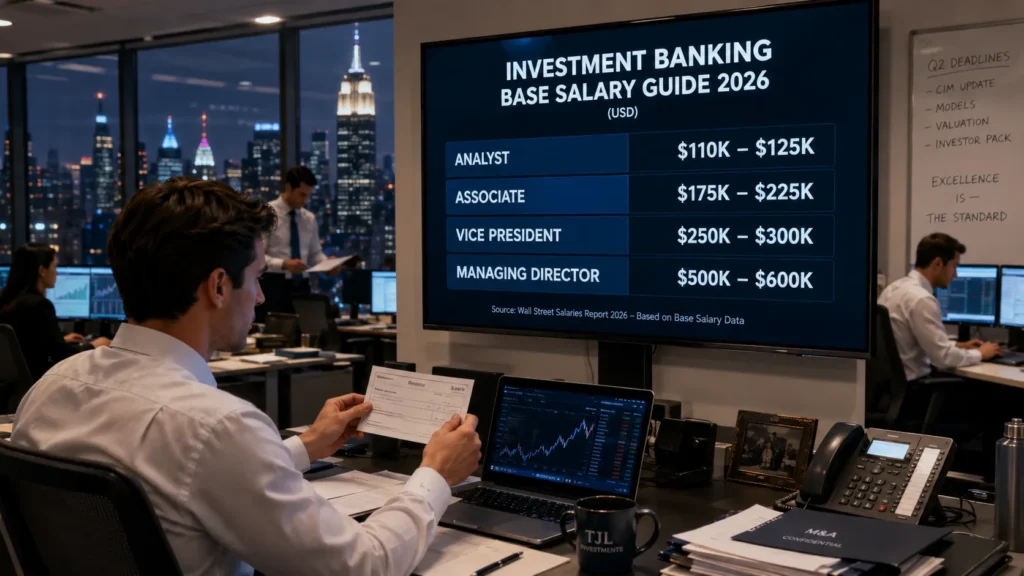
By the time a professional reaches the Associate level (usually three years in, or entering directly post-MBA), base pay leaps to the $175,000 to $225,000 range. Vice Presidents (VPs) command bases of $250,000 to $300,000, while Directors and Managing Directors (MDs) often max out their guaranteed base pay around $500,000 to $600,000.
While these guaranteed numbers sound massive to the general public, any seasoned banker will tell you that the base salary simply covers the staggering cost of living in global financial capitals and the incredibly heavy local tax burdens. The real, life-changing wealth is built in February.
The Golden Carrot: The Year-End Bonus
If base pay keeps the lights on, the year-end performance bonus is what buys the Hamptons house or funds early retirement. Paid out typically in late January or February for the preceding calendar year’s work, the bonus is a variable, highly discretionary lump sum. It is the defining feature of any investment banker salary.

Bonuses are completely reliant on three interconnected variables:
- The Macro Environment: Did the global economy support high deal volume and strong equity markets?
- The Group’s Performance: Did your specific team (e.g., Technology M&A, Healthcare Capital Markets, or Leveraged Finance) close lucrative deals and bring in top-tier fees?
- Individual Performance: How did you rank against your direct peers?
Banks do not distribute bonus pools equally. They utilize a ruthless, forced-ranking system commonly referred to as “bucketing.”
- Top Tier (Top 10-15%): These are the relentless workhorses. The analysts and associates who flawlessly execute complex financial models at 3:00 AM without complaint and anticipate client needs before they are voiced. In a strong year like 2026, top-bucket performers routinely see a cash bonus equivalent to 85% to 105% of their base salary.
- Middle Tier (The 70% Majority): The solid, dependable bankers. They do their jobs well, rarely make fatal modeling errors, but perhaps aren’t the absolute stars of the bullpen. They typically see bonuses ranging from 50% to 85% of their base.
- Bottom Tier (Bottom 10-15%): Often referred to colloquially as a “doughnut” or a “goose egg,” being placed in the bottom bucket is the bank’s polite, financial way of telling you to update your resume and look for a new career. Bonuses here can be zero, or a meager 10% to 20%.
For an analyst with a $115,000 base placed in the top tier, an $80,000 to $100,000 bonus brings their total first-year cash compensation well over the $200,000 mark.
The Golden Handcuffs: Deferred Compensation and Stock
At the junior levels (Analysts and early Associates), compensation is almost entirely paid in all-cash. The firm knows junior bankers are paying off student debt and building their financial footing. But as you climb the ladder, the bank intentionally changes the formula to protect its long-term interests.
Once your total investment banking salary crosses a certain threshold—usually around the mid-Associate or early VP level—a significant portion of your annual bonus (often 20% to 40%) is no longer paid in cash. Instead, it is awarded as deferred compensation.

This deferred pay comes in the form of Restricted Stock Units (RSUs) or Performance Share Units (PSUs) tied directly to the bank’s stock price. Crucially, this stock vests gradually, typically over a three-to-four-year period.
Why do banks implement this? It creates a highly effective system of “golden handcuffs.” If a high-performing Vice President wants to quit in frustration and join a rival elite boutique firm, they must forfeit all unvested stock—often walking away from hundreds of thousands of dollars left on the table. (This dynamic is exactly why you frequently hear of rival banks paying massive “buyout bonuses” to make a poached employee whole).
Furthermore, deferred compensation is subject to strict “clawback” provisions. In the heavily regulated post-2008 environment, if a Managing Director aggressively closes a deal that later results in massive regulatory fines, compliance failures, or catastrophic losses for the bank, the institution retains the legal right to cancel their unvested stock and claw back past earnings.
The Entry Fee: Signing Bonuses and The “Stub”
Before you even open Excel to run your first discounted cash flow (DCF) analysis, money changes hands. The war for top financial talent begins aggressively on university campuses and at top-tier MBA programs.
To lock in highly sought-after candidates, banks offer upfront signing bonuses. A fresh undergraduate accepting a first-year analyst offer might receive $10,000 to $15,000 just for signing the employment contract. For post-MBA Associates who are actively courted by multiple firms, signing and relocation packages routinely hit $50,000 to $60,000 to cover cross-country moves and immediate living expenses.

The Stub Bonus Explained
Because the traditional banking compensation cycle operates strictly on a calendar year (with bonuses paid in early Q1 for the previous January-December period), new hires face a timing misalignment. Most new analysts and associates graduate in May and finally hit the desk in July or August after completing their licensing exams and training.
When bonus season arrives a few months later, they haven’t worked a full 12-month year. To account for this logically, banks pay out a “stub bonus.” This is a pro-rated, fractional bonus covering their first four to five months on the job. For a first-year associate starting in August in New York, a stub bonus might comfortably range from $30,000 to $40,000, serving to tide them over until their first full-year bonus cycle hits the following winter.
Understanding this four-pillar architecture is absolutely critical. When mainstream media reports that a Wall Street executive makes “$3 million a year,” it rarely means they are drawing a smooth $250,000 monthly salary. It means a delicate, highly stressful alchemy of base pay, cash performance bonuses, and vesting stock has aligned perfectly during a bullish market cycle.
3. Investment Banking Analyst Salary: Surviving the First 3 Years
To understand the entry point of Wall Street compensation, you have to look at the analyst class. These are the 22-year-olds fresh out of target undergraduate business programs like Wharton, Stern, and LSE. They are the engines of the bank, responsible for the heavy lifting of financial modeling, assembling endless pitch decks (the infamous “PowerPoint formatting”), and conducting exhaustive industry research.
Entering 2026, the investment banking analyst salary has been radically adjusted upward to prevent top-tier graduates from defecting to Silicon Valley or elite quantitative trading firms.
2026 Analyst Salary Bands (Bulge Bracket vs. Elite Boutique)
The compensation at this level is entirely cash-based. Elite Boutiques (EBs) like Centerview, Evercore, and Lazard generally pay a premium over Bulge Brackets (BBs) like Goldman Sachs or JPMorgan, mostly driven by higher cash bonuses.
| Analyst Level | Bulge Bracket Total Pay (USD) | Elite Boutique Total Pay (USD) | Base Salary Floor |
| Year 1 (AN1) | $180,000 – $220,000 | $210,000 – $275,000+ | $110,000 – $120,000 |
| Year 2 (AN2) | $210,000 – $265,000 | $250,000 – $300,000+ | $125,000 – $135,000 |
| Year 3 (AN3) | $240,000 – $290,000 | $285,000 – $350,000+ | $135,000 – $150,000 |
Note: Data derived from 2026 compensation reports by Harrison Rush and Wall Street Prep. Figures reflect top-bucket performers in major US hubs like NYC.
The “Per-Hour” Reality Check
Looking at a $200,000 banker investment salary at age 23 sounds exhilarating. However, seasoned bankers often joke about the “hourly wage reality.” An entry-level analyst routinely works 80 to 100 hours per week.
If we take a standard Year 1 analyst working 90 hours a week for 50 weeks a year, that equates to 4,500 hours worked. Divide a $200,000 total compensation package by 4,500 hours, and the true hourly rate is roughly $44.44 per hour. For context, a mid-level software engineer working a strict 40-hour week for $150,000 is earning roughly $75.00 per hour.
Case Study: A Day in the Life of a NYC Analyst
Consider “David,” a Year 1 Analyst in a prestigious M&A group in Manhattan.
- 9:00 AM: Arrives at the desk. Reviews overnight emails from the London office.
- 10:30 AM: Receives a “mark-up” (edits) on a pitch deck from his Vice President.
- 2:00 PM: Eats a rushed salad at his desk while building a complex Discounted Cash Flow (DCF) model in Excel.
- 7:00 PM: The Managing Director requests a completely new financial scenario for a client meeting tomorrow. The real work begins.
- 11:30 PM: Orders a $35 dinner on the company’s “Seamless” expense account.
- 2:30 AM: Sends the final model to the VP for approval. Takes a black car home (paid by the bank).
David is pulling in an incredible investment banking salary, but his personal life is virtually non-existent. This dynamic is exactly why the analyst stint is typically viewed as a two-to-three-year boot camp before exiting to private equity or venture capital.
4. The Associate Years: Breaking into Mid-Level Management
If you survive the analyst meat grinder without burning out—or if you enter the industry fresh from a top-tier MBA program like Harvard, Stanford, or Booth—you become an Associate.

The transition from Analyst to Associate marks a fundamental shift. You are no longer just the “Excel monkey.” Associates are expected to project-manage the analysts, double-check models for fatal errors, communicate directly with clients on day-to-day data requests, and begin understanding the strategic narrative behind a merger or acquisition.
The MBA vs. A-to-A Dynamic
There are two paths to the Associate desk. The “A-to-A” (Analyst-to-Associate) promote is a junior banker who proved their worth and skipped business school. They are heavily favored by Managing Directors because they already possess three years of elite technical modeling skills.
The post-MBA Associate, while possessing incredible pedigree and soft skills, often requires a brutal six-month ramp-up period to match the Excel speed of a third-year analyst. Despite this, both cohorts are paid on the same structured salaries investment banking grids.
2026 Associate Compensation Jumps
At the Associate level, the total compensation curve begins to steepen aggressively. Furthermore, this is the stage where banks begin implementing deferred compensation. A portion of the year-end bonus (typically 15% to 25%) will be locked up in vesting company stock.
| Associate Level | Bulge Bracket Total Pay | Elite Boutique Total Pay | Base Salary Floor |
| Year 1 (ASO1) | $275,000 – $375,000 | $350,000 – $450,000+ | $175,000 – $185,000 |
| Year 2 (ASO2) | $350,000 – $450,000 | $425,000 – $550,000+ | $200,000 – $210,000 |
| Year 3 (ASO3) | $400,000 – $525,000 | $500,000 – $650,000+ | $225,000 – $250,000 |
By the time an Associate finishes their third year, they are regularly crossing the half-million-dollar mark. The trade-off? The hours are only marginally better than the analyst years (averaging 70 to 80 hours a week), but the stress is significantly higher. If a model has a fatal error and makes it to the client, the Associate takes the blame, not the Analyst.
5. Vice President (VP): The Transition to Deal-Maker
Around age 28 to 32, a successful Associate is promoted to Vice President. This is widely considered the hardest transition in an investment banker salary trajectory.

As a junior banker (Analyst/Associate), your value is purely tied to execution. How fast can you build a model? How perfect is your slide deck? As a VP, execution is assumed. Your new mandate is to manage the junior team seamlessly while simultaneously learning how to originate business. You are transitioning from an internal processor to an external revenue generator.
The Tipping Point in Compensation
A VP is the linchpin of any live deal. They run the working group calls, negotiate with the lawyers, field aggressive questions from the private equity buyers, and ensure the Managing Director is prepped for the final pitch.
| VP Level | Bulge Bracket Total Pay | Elite Boutique Total Pay | Base Salary Floor |
| Year 1 (VP1) | $500,000 – $750,000 | $650,000 – $850,000+ | $250,000 – $275,000 |
| Year 2 (VP2) | $550,000 – $700,000 | $680,000 – $850,000+ | $275,000 – $300,000 |
| Year 3 (VP3) | $650,000 – $825,000 | $750,000 – $950,000+ | $300,000 – $350,000 |
At the VP level, the cash-to-stock ratio shifts further. Upwards of 30% to 40% of a VP’s bonus may be paid in restricted stock. This is where the “golden handcuffs” lock in. A VP looking to leave a Bulge Bracket bank in 2026 might have $400,000 in unvested stock on the table—making an exit to corporate finance or a tech startup incredibly painful financially.
VPs work fewer weekend hours than analysts, but their mental load is continuous. They are checking emails on vacation, stepping out of weddings to take client calls, and flying across the country at a moment’s notice.
6. Directors and Managing Directors (MD): The Million-Dollar Rainmakers
If you survive 10 to 12 years in the industry, you reach the absolute pinnacle of the hierarchy: Managing Director (some banks use the title Executive Director or Partner). This is the level that creates the legendary, generational wealth associated with Wall Street.
The “Eat What You Kill” Model
At the MD level, the guaranteed investment banking salary structure practically vanishes in importance. While an MD might have a base salary of $400,000 to $600,000, that is merely a rounding error compared to their bonus potential.

An MD is a pure salesperson. Their only job is to leverage their deep rolodex of CEO and private equity contacts to win mandates. If an MD successfully advises a healthcare conglomerate on a $5 billion acquisition, the bank might charge a fee of $15 million. A percentage of that fee directly funds the MD’s year-end bonus pool.
- Average Bulge Bracket MD: $800,000 – $1.6M+ Total Compensation.
- Top-Performing Elite Boutique MD: $1.2M – $2.5M+ Total Compensation.
- The “Rainmakers” (Star MDs closing mega-deals): $5,000,000 to $10,000,000+ per year.
The Zero-Bonus Stress
However, with absolute reward comes absolute risk. If an MD spends an entire year flying around the world, taking CEOs to expensive dinners, and pitching deals—but fails to actually close a transaction—their bonus can literally be zero.
In bad macroeconomic years (like the drought of 2023), it was common to see underperforming MDs “zeroed out” and subsequently fired. You are only as valuable as the revenue you generated in the last twelve months. At this level, salaries investment banking professionals earn are not about hours worked; they are strictly a commission on capitalism.
7. Not All Banks Pay the Same: Firm Classification
A common trap for ambitious finance graduates is assuming that the logo on the building doesn’t matter when it comes to payday. In reality, the specific classification of the financial institution you work for radically dictates the ceiling of your investment banker salary. Wall Street is not a monolith; it is a fractured ecosystem of balance-sheet behemoths, hyper-specialized advisory shops, and regional players.

To accurately project your earnings, you must understand the three distinct tiers of investment banks and how their unique business models fund their compensation pools.
The Bulge Brackets (BB): The “Flow Monsters”
When the general public imagines Wall Street, they picture the Bulge Brackets. These are the universal, full-service global banks: Goldman Sachs, JPMorgan Chase, Morgan Stanley, Bank of America, and Citi.
Bulge Brackets do everything. They advise on M&A, but they also underwrite massive IPOs, trade fixed income, offer wealth management, and lend billions from their own balance sheets to fund corporate acquisitions. Because they have massive overhead, tens of thousands of employees, and strict regulatory capital requirements, their compensation models are heavily structured.
- The Pay Dynamic: BBs offer the “standard” market rate for an investment banking salary. You will be paid exceptionally well, but your bonus is highly dependent on the overall bank’s performance, not just your specific group. If the M&A team crushed it, but the fixed-income trading desk lost a billion dollars, your bonus might still be compressed to subsidize the bank’s broader losses.
- The Stock Trap: As discussed in Phase 2, BBs heavily utilize deferred stock for bonuses once you hit the Associate and VP levels. You might “make” $600,000 on paper, but $200,000 of that is locked up in Morgan Stanley stock vesting over three years.
The Elite Boutiques (EB): The High-Cash Payouts
Elite Boutiques like Centerview Partners, Evercore, PJT Partners, Lazard, and Moelis & Company operate on a fundamentally different model. They do not lend money. They do not have massive retail banking divisions. They are purely strategic advisory firms. A CEO hires them solely for their brainpower and negotiation tactics during a merger, acquisition, or restructuring.
Because EBs have incredibly low overhead and run highly “lean” deal teams, their profit margins per employee are staggering.
- The Pay Dynamic: This is where the absolute highest banker investment salary figures are found. A top-bucket analyst at an Elite Boutique in 2026 can pull in 20% to 30% more than their peers at Goldman Sachs. For instance, Centerview Partners is legendary for paying its first-year analysts a base salary of $130,000—well above the street average.
- All-Cash Bonuses: Unlike the Bulge Brackets, many Elite Boutiques pay out bonuses in 100% cash well into the VP and even early Director levels.
- The Catch: The hours are notoriously brutal. Because the teams are leaner, an investment banking analyst salary at an EB is earned through punishing, relentless execution. If a Bulge Bracket puts five people on a pitch, an Elite Boutique might only use three. There is nowhere to hide.
Middle Market (MM) & Regional Boutiques
Firms like William Blair, Houlihan Lokey, Piper Sandler, and Jefferies (which skirts the line between MM and BB) focus on deals typically valued under $1 billion.
- The Pay Dynamic: Base salaries often mirror the Bulge Brackets, but the bonus pools are generally smaller because the deal fees are smaller. A Middle Market VP might cap out around $450,000 to $550,000, whereas a Bulge Bracket VP could push $750,000.
- The Trade-off: Mid-market firms often offer a marginally better lifestyle. You are still working hard, but the “facetime” culture and weekend grind are occasionally more forgiving. For many bankers looking to start a family, taking a 15% pay cut for a 20% reduction in hours is a highly attractive proposition.
8. Global Geographic Pay Disparities
Finance is a global game, but the compensation isn’t. An analyst building a leverage buyout (LBO) model in London is doing the exact same work as an analyst in New York, yet their take-home pay is vastly different. When analyzing salaries investment banking professionals earn, geography is the ultimate multiplier—or detractor.
Fidelity Investments Careers: The Ultimate Insider’s Guide to Landing Your Dream Role

New York City: The Undisputed King of Gross Pay
Wall Street remains the center of gravity for global finance. Over 50% of global investment banking fees are generated in the Americas, and NYC is the engine room.
- Compensation: NYC offers the highest absolute gross pay in the world. This is the benchmark against which all other cities are measured.
- The Reality: The eye-watering numbers are immediately offset by exorbitant state and city taxes, plus a cost of living that makes a $200k income feel decidedly middle-class in Manhattan. (We will break down this exact tax math in Phase 4).
London & Europe: The Post-Cap Rebound
For over a decade, London bankers were handicapped by the European Union’s strict bonus cap, which legally limited bonuses to 200% of a banker’s base salary. To compensate, London banks artificially inflated base salaries (often via “role-based allowances”) but the total ceiling remained lower than in the US.
In late 2023, UK regulators officially scrapped the bonus cap to make the City of London more competitive post-Brexit. Now, in 2026, we are finally seeing the delayed effects of this policy shift.
- Compensation: London bonuses are surging back, unchained from regulatory limits. However, the total investment banking salary in London still generally trails New York by roughly 15% to 25% when converted to USD.
- The European Dynamic: In cities like Frankfurt and Paris, total compensation is even lower, driven by stronger labor laws, mandated vacation times, and a cultural aversion to the 100-hour American workweek. You make less, but you actually get to see your family on a Sunday.
Asia-Pacific (Hong Kong & Singapore): High Bases, Low Taxes
The APAC region is a fascinating dichotomy. Historically, Hong Kong was the gateway to massive Chinese state-owned enterprise (SOE) IPOs, leading to booming paydays. However, geopolitical tensions and shifting economic policies have redirected massive capital flows toward Singapore, establishing a fierce rivalry between the two hubs.
- Compensation: Gross pay for expat bankers in HK and Singapore is roughly on par with London, sometimes slightly higher. Banks often provide “housing allowances” and cost-of-living adjustments that technically inflate the base package.
- The Tax Arbitrage: This is the secret weapon of the APAC banker. While a New York banker loses nearly 45% of their bonus to taxes, a banker in Hong Kong is taxed at a maximum of roughly 15%. A banker in Singapore maxes out around 22%. Therefore, a $500,000 total compensation package in Singapore results in drastically more net cash in the bank than the exact same package in Manhattan.
India: The Rapid Rise of the Domestic Hub
Historically, Western banks utilized India (specifically Bangalore, Hyderabad, and Pune) strictly for “knowledge process outsourcing” (KPO)—offshore back-office teams that scrubbed data or formatted PowerPoint slides overnight for NYC bankers.
By 2026, this narrative has completely fractured. Mumbai has exploded into a premier front-office financial hub, driven by massive domestic M&A activity and the rise of the Indian middle class.
- Compensation: While a domestic investment banking analyst salary in Mumbai does not equal a New York salary in absolute dollar terms, it is astronomical when adjusted for Purchasing Power Parity (PPP). Top Indian analysts at global banks are pulling in base salaries of ₹25 Lakhs to ₹35 Lakhs, with bonuses pushing total compensation well over ₹50 Lakhs ($60,000+ USD) in their first few years. In the context of the local economy, this places them in the top 1% of earners almost immediately upon graduation.
The Mid-Point Summary
By now, it should be clear that the headline numbers thrown around in the media rarely tell the whole story. Whether you are earning pure cash at an Elite Boutique in Manhattan or leveraging the tax advantages of Singapore, the raw compensation is unparalleled for young professionals.
But what does a $250,000 salary actually look like when the government takes its cut, and you have to pay $4,500 a month in rent just to live close enough to the office to survive the 3:00 AM departures?
9. Tax Implications and the Cost of Living Mirage
When an aspiring analyst looks at a six-figure starting package, their eyes usually glaze over the gross numbers. They run immediate mental calculations on what sports car or luxury apartment that capital can secure. What they fail to account for is the reality of the fiscal buzzsaw that awaits them. The truth about a high investment banker salary is that it is highly concentrated in the most aggressively taxed jurisdictions on earth, and the government treats Wall Street bonuses with a unique level of severity.

The Brutal Reality of the Manhattan Tax Bracket
If you are pulling in a top-tier investment banking salary in New York City, you are subjected to a multi-tiered taxation structure that catches many off guard: Federal income tax, New York State income tax, and the infamous New York City local resident income tax.
For a single earner crossing the $200,000 threshold in total compensation, the marginal tax bracket spikes rapidly.
- The Bonus Penalty: While base salaries are taxed on standard progressive payroll grids, year-end bonuses are frequently categorized as supplemental wages. Employers often flat-rate withhold federal taxes on supplemental wages at 22% right off the top. When you layer on State withholding, City tax, and FICA, it is entirely common to see 40% to 45% of your year-end bonus check vanish before it ever hits your bank account.
- The Net Reality: If you earn a $120,000 base and a $90,000 bonus ($210,000 total), your actual take-home cash after all deductions in NYC hovers closer to $125,000 to $130,000.
The Cost of Living Squeeze
To compound the tax burden, you have to look at where investment banking jobs require you to live. To survive 90-hour weeks, junior bankers must live close to the office. In Manhattan, this means targeting neighborhoods like Murray Hill, the Financial District, or Tribeca.
As we navigate 2026, the average rent for a modest one-bedroom apartment within a 15-minute radius of midtown or Wall Street routinely exceeds $4,500 a month. Factor in expensive late-night convenience meals, dry cleaning for premium business attire, high-priced gym memberships you barely have time to use, and general inflation, and that massive entry-level investment banking analyst salary begins to look remarkably modest. It provides an undeniably comfortable lifestyle, but it does not make you instantly wealthy.
10. Work-Life Balance, Burnout, and the “True” Hourly Wage
The financial trade-offs of finance are accompanied by a profound psychological cost. The debate over whether the massive compensation justifies the physical toll has reached a boiling point, prompting unprecedented structural changes across major institutions.
The 2026 Tracking Crackdown: Surveillance vs. Well-being
For years, bulge bracket banks gave lip service to protecting junior staff by introducing “protected Saturdays” or formal 80-hour weekly caps. However, Wall Street culture possesses a powerful subtext: if you leave early, you are viewed as uncommitted, which directly damages your year-end bucket ranking.

This friction has caused a massive operational shift. Major firms have realized that junior bankers frequently misreport their hours—intentionally logging fewer hours than they actually worked to avoid being flagged by HR or removed from high-profile, live deal streams.
To combat this, firms like JPMorgan Chase have launched pilot programs designed to electronically monitor junior workloads. Instead of relying purely on honor-system logs, these internal tracking systems cross-reference self-reported times against:
- Keystroke data and software activity logs
- Internal desktop application usage
- Daily Zoom, Microsoft Teams, and email timestamps
The banks claim this screen-time summary approach is designed to foster transparency, prevent catastrophic burnout, and protect health. However, many junior staff view it as an intrusive layer of digital surveillance. Despite these high-tech initiatives and the widespread integration of generative AI tools meant to automate mundane presentation formatting and data aggregation, industry data shows that the actual workload hasn’t dropped. The average first- and second-year analyst is still clocking 80 to 81 hours a week on average, with live M&A transactions pushing those totals past 100 hours.
The Deceptive Math of the True Hourly Wage
When you look closely at how salaries investment banking professionals take home break down against actual hours logged on the desk, the economic premium narrows significantly.
Let’s look at the mathematical reality of a top-tier performer versus an equivalent corporate alternative:
Scenario A: First-Year Investment Banking Analyst
Total Compensation: $200,000
Average Weekly Hours: 85 hours (50 weeks/year = 4,250 hours)
True Hourly Wage: ~$47.05 per hour

Scenario B: Elite Corporate Tech/Software Engineer
Total Compensation: $150,000
Average Weekly Hours: 42 hours (50 weeks/year = 2,100 hours)
True Hourly Wage: ~$71.42 per hour
When viewed through this analytical lens, a tech engineer or specialized strategic consultant often earns a significantly higher rate per hour of life surrendered. The difference is that investment banking acts as a wealth accelerator; it forces a massive volume of hours—and consequently, a massive pile of absolute cash—into a tightly compressed timeframe at the absolute start of your career.
You are effectively selling your youth to the bank in exchange for a permanent premium on your lifetime earning potential and an unrivaled technical foundation. But anyone stepping into this arena purely for a high banker investment salary without a deep, genuine fascination for corporate dealmaking will find that the psychological burnout catches up to them long before the first major stock allocation vests.
JPMorgan Tracker for Junior Banker Work Hours
This video outlines the real-world operational changes on Wall Street, specifically illustrating how top firms are using technology to track keystrokes and monitor the actual hours worked by junior staff to combat burnout.
11. Exit Opportunities: The Buy-Side Mirage
For a significant percentage of junior professionals, earning a high investment banking salary is not a lifelong career goal—it is a grueling two-year trade-off. The goal is to survive the analyst bullpen, build an elite financial modeling foundation, and leverage that prestige to “exit” to the buy-side.

The buy-side refers to institutions that invest capital directly rather than advising others on how to spend it. However, many junior bankers operating on Wall Street discover that moving to the buy-side presents unexpected financial and cultural realities.
Private Equity (PE) vs. Hedge Funds (HF)
Private equity remains the default, hyper-competitive destination for top-performing investment banking analysts.
- The Compensation Reality: At mega-funds (such as Blackstone, KKR, or Carlyle), an entry-level associate’s compensation can easily eclipse a second-year investment banking analyst salary, frequently ranging from $300,000 to $450,000 all-in.
- The Catch—Carried Interest: The real wealth in private equity is built through “carry”—a percentage of the investment profits generated by the fund. However, junior associates rarely see carried interest; it is typically reserved for Vice Presidents and Partners, and it takes 5 to 7 years to vest.
- Hedge Funds: For those exiting to quantitative or long/short equity hedge funds, the compensation structure is even more volatile. If your portfolio manager has a spectacular year, your bonus can dwarf anything paid by a traditional bank. If the fund finishes the year down 10%, your bonus can instantly hit zero, and fund liquidations can lead to sudden layoffs.
Corporate Development and Venture Capital (VC)
For bankers willing to trade absolute cash compensation for personal time and lifestyle sustainability, the corporate world offers clear paths.
- Corporate Development: Joining the internal M&A or strategic growth team of a major corporation (like Google, Disney, or Nike) involves a distinct trade-off. Your total compensation will likely drop by 30% to 50% compared to mid-level salaries investment banking professionals command. However, your weekly hours drop from 85 down to a predictable 45 to 50, and travel demands decrease significantly.
- Venture Capital: While highly romanticized, early-stage venture capital typically pays lower starting cash packages than private equity or investment banking. You are trading immediate salary liquidity for the long-term, highly speculative upside of startup equity options.
12. Frequently Asked Questions (FAQ)
What is the average starting salary for an investment banker?
Entering 2026, the average starting total compensation for a first-year front-office investment banking analyst at a global bulge bracket bank ranges from $180,000 to $220,000 in major US hubs. This package typically breaks down into a guaranteed base salary of $110,000 to $120,000, supplemented by a performance-dependent year-end cash bonus ranging from $70,000 to $100,000+.
Who pays higher investment banker salaries: Goldman Sachs or Elite Boutiques?
Elite Boutique investment banks (such as Centerview Partners, Evercore, and Moelis) consistently pay higher total compensation packages than traditional Bulge Bracket banks like Goldman Sachs or JPMorgan Chase. Elite Boutiques maintain smaller deal teams, low balance-sheet overhead, and lower operating costs, allowing them to pay higher analyst bases (up to $130,000) and distribute up to 100% of year-end bonuses in pure cash rather than deferred stock.
Are investment banking bonuses guaranteed?
No. Investment banking bonuses are entirely discretionary and performance-dependent. They are determined at the end of the fiscal year based on three core metrics: the macroeconomic environment and market deal volume, the total advisory fees generated by your specific industry sector or product group, and your individual performance tier (“bucket ranking”) relative to your peer group. Underperforming bankers can receive a “doughnut”—industry slang for a zero bonus.
Can you earn an investment banker salary without an Ivy League degree?
Yes, though the path requires aggressive networking. While global bulge brackets recruit heavily from “target schools” (such as Wharton, Harvard, NYU Stern, and UChicago), non-target graduates frequently break into the industry via lateral hiring. This involves starting at a boutique or middle-market firm, mastering financial modeling, and transitioning to a larger investment bank after 12 to 24 months of verified deal execution.
13. Conclusion: Is the Sacrificial Wealth Worth It?
Navigating the financial architecture of Wall Street reveals a clear truth: an investment banker salary is not free money. It is a highly calculated, highly structured financial transaction where you sell your physical energy, mental health, and personal relationships to an institution in exchange for compressed, generational wealth acceleration.
The structural adjustments seen across major banks emphasize that the industry must continue evolving to retain elite talent. If your primary motivation is simply securing a high income, alternative paths in enterprise software sales, technology engineering, or specialized quantitative data analysis frequently yield a superior hourly return on your time.
However, for those with a genuine fascination for high-stakes corporate negotiation, complex financial structuring, and the fast-paced dynamics of global capitalism, investment banking remains the premier corporate launching pad. It provides an unmatched professional foundation, an elite network of peers, and a lifetime earnings trajectory that few other professions on earth can replicate.