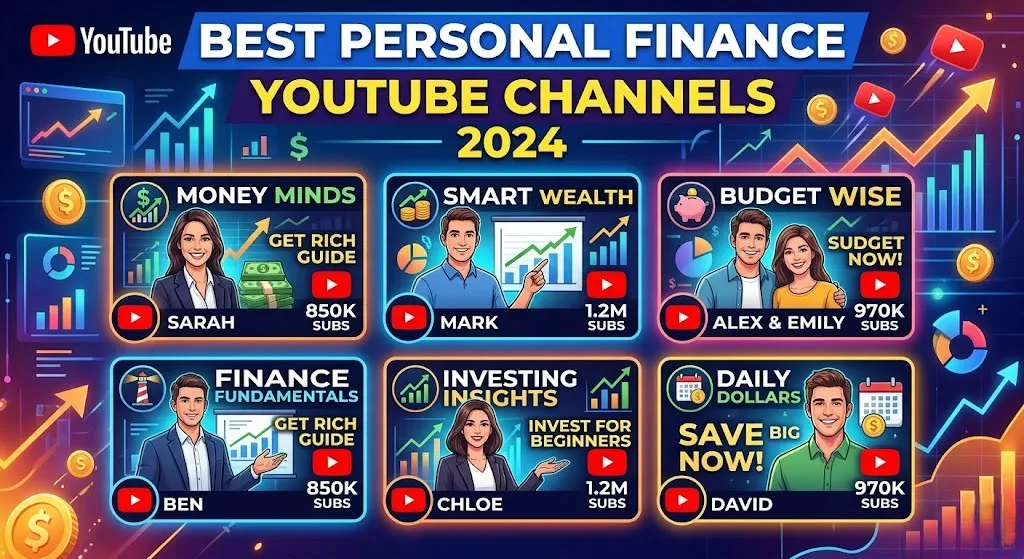
In an era where market volatility, crypto-fluctuations, and shifts in global banking are constant, the ability to parse noise from legitimate financial signals is a superpower. You don’t need a degree from Wharton to master your money; you just need to know which voices to trust. Here are the Best Personal Finance YouTube Channels
The landscape of personal finance on YouTube has matured significantly by 2026. We’ve moved past the “get rich quick” phase of the early 2020s and into an era of high-fidelity, data-driven education. If you are looking to audit your habits, build a passive income stream, or simply understand why your tax bracket is moving the way it is, these are the channels that currently move the needle.
1. The Strategy-Focused Educators
These creators don’t just talk about money; they provide the “operating systems” for financial success.
The Money Guy Show
If you’re looking for a structured, professional framework, look no further. Brian Preston and Bo Hanson, both Certified Financial Planners (CFPs), treat your finances like a technical project. Their “Financial Order of Operations” (FOO) is arguably the gold standard for how to prioritize every dollar you earn, from high-interest debt elimination to tax-advantaged investing.
- Best for: Someone who wants a “rules-based” system rather than guessing what to do next.
MappedOutMoney
Nick True’s channel is a masterclass in behavioral finance. He doesn’t just show you how to use a spreadsheet; he shows you how to think about your money. His deep dives into tools like YNAB (You Need A Budget) are essential viewing for anyone who feels like they’re living paycheck-to-paycheck despite a decent salary.
- Best for: People who feel “organized chaos” and need a clean, repeatable system to get control of their spending.
Finance With Sharan (Sharan Hegde)
Sharan is a massive force in the modern “edutainment” space, particularly for those looking to bridge the gap between traditional investing and the digital-first economy.
- Why he fits: He masterfully breaks down complex financial concepts—like mutual funds, crypto-assets, and modern tax laws—using humor and high-energy visuals. His style is perfect for Gen Z and Millennials who find traditional finance dry.
- Best for: Someone who wants the “need-to-know” on modern portfolio management without feeling like they are sitting in a college lecture.
2. The Market Analysts & Realist Philosophers
These channels bridge the gap between complex market news and your personal portfolio.
Graham Stephan
Yes, he’s a household name, but his channel remains a staple for a reason: raw transparency. In 2026, Stephan’s content has evolved from “how to save on coffee” to rigorous deep dives into market cycles and the intersection of real estate and liquidity. His “reaction” videos act as a filter for the chaotic financial news of the day.
- Best for: Someone who wants a daily pulse check on the economy without the boring, dry delivery of traditional cable news.
WhiteBoard Finance
Marko Zlatic’s approach is refreshing because he breaks down complex investing topics—like dividend growth, real estate syndication, and tax-loss harvesting—on a physical whiteboard. He pulls from his professional background as a financial student and investor to explain why something works, not just what to buy.
- Best for: Visual learners who want the “how-to” behind wealth-building strategies.
CA Rachana Phadke Ranade
If you want professional-grade education that doesn’t sacrifice clarity, Rachana Phadke Ranade is your go-to. As a Chartered Accountant, her channel is rooted in deep professional knowledge.
- Why she fits: She excels at teaching the “mechanics” of the stock market. Whether it is reading a balance sheet, understanding quarterly results, or demystifying technical analysis, she explains complex professional-level concepts in a way that an absolute beginner can grasp.
- Best for: Someone who wants to learn the fundamental accounting and logic behind how stock markets actually work.
The Ultimate Personal Finance Books Guide: Read Your Way to Real Wealth
3. The Human-Centric Perspective
Finance isn’t just math; it’s an emotional journey. These channels tackle the “human” side of the balance sheet.
The Financial Diet
Chelsea Fagan and her team have built a corner of the internet where finance isn’t a taboo subject. They focus on the “why” of our spending—the lifestyle creep, the social pressure, and the career choices that dictate our long-term wealth. They excel at debunking money myths that keep people stuck in cycles of debt.
We touched on them briefly before, but they are essential to add to this list. They are the best channel for the “social” side of money.
- Why they fit: They acknowledge that money is a messy, emotional subject. They cover everything from how to have difficult money conversations with your partner to how your career choice impacts your mental health.
- Best for: Someone looking for a holistic, lifestyle-focused approach to finance rather than just stock picking or budgeting app reviews.
- Best for: Anyone who feels intimidated by the “Wall Street” vibe of other channels and wants a more relatable, lifestyle-oriented approach.
The Plain Bagel (Peter A. Kristensen)
Peter is a financial analyst who specializes in cutting through the hysteria of financial news. He provides arguably the most calm, rational analysis on YouTube.
- Why he fits: His channel is a fantastic antidote to the “panic-selling” culture of financial news. He focuses on macro-economics, behavioral finance, and understanding market history. He doesn’t tell you what to buy; he explains the economic environment so you can make your own decisions.
- Best for: The rational investor who wants to understand the “big picture” of how the global economy works.
How to Curate Your Financial Feed
YouTube’s algorithm will feed you whatever you click on. If you want to actually learn, you have to train it.
- Avoid “Clickbait” Wealth-Farming: If a video title promises you “The secret to 1000% returns,” close the tab. Legitimate wealth building is boring, slow, and consistent.
- Verify Qualifications: While creators like Graham Stephan offer great market commentary, always cross-reference advice with licensed professionals or Investopedia for foundational definitions.
- Cross-Pollinate: Don’t just watch one creator. Watch a video on “The Money Guy” for strategy, then a “Financial Diet” video for the behavioral side. The intersection of those two perspectives is where real financial wisdom lives.
Updated Curated Financial Feed
If you want to have a well-rounded financial education, I suggest rotating through these specific “angles”:
| Channel | Focus Angle |
|---|---|
| Finance With Sharan | Modern, Digital-First, Fast-Paced Education |
| CA Rachana Phadke Ranade | Professional, Accounting-Based, “How-To” Analysis |
| The Plain Bagel | Macro-Economic, Rational, Calm Market Theory |
| The Financial Diet | Behavioral, Lifestyle, & Relationship-Based |
| Rob Berger | Analytical, Deep-Dive Product & Tool Testing |
By watching one video from each of these categories, you’ll get a 360-degree view of finance: the math (Rachana), the strategy (Sharan), the market reality (Peter), the behavior (Chelsea), and the tools (Rob).
FAQ: Getting the Most Out of Financial YouTube
Q: Can I actually get a financial education just from YouTube?
A: You can build a robust foundation, but think of it as “Financial Literacy 101.” YouTube excels at teaching you concepts and strategies. It cannot replace the personalized, fiduciary advice of a real-world planner who understands your specific tax situation, estate goals, and family dynamics.
Q: How do I know if a “financial guru” is legitimate?
A: Look for creators who talk about risk as much as they talk about reward. A red flag is someone who guarantees specific returns. Legitimate educators will always emphasize that market performance is never a guarantee and that diversification is the only “free lunch” in investing.
Q: How do I avoid getting distracted by “Get Rich Quick” content?
A: Focus on “evergreen” content. Videos titled “How to invest in Index Funds” or “Understanding the basics of a 401(k)” are almost always more valuable than videos titled “The next big Crypto Moonshot.” Evergreen content is designed to educate; hype content is designed to sell.
Q: Are there specific channels for tax advice?
A: Yes. Channels like Mark J. Kohler’s are excellent for understanding the tax code, but remember: tax law changes every year and varies by country and state. Treat these videos as conversation starters to have with your personal CPA, not as final legal advice.
Q: Why do so many finance YouTubers also sell courses?
A: It’s their business model. Many creators monetize their audience by selling deeper-dive masterclasses. While some courses are legitimately helpful, you should never feel pressured to buy a course to learn the basics. 90% of what you need to know about personal finance is available for free across these channels.
Disclaimer: This guide is for educational purposes only. Financial markets carry inherent risks. Always conduct your own due diligence or consult with a qualified financial advisor before making significant investment decisions.